
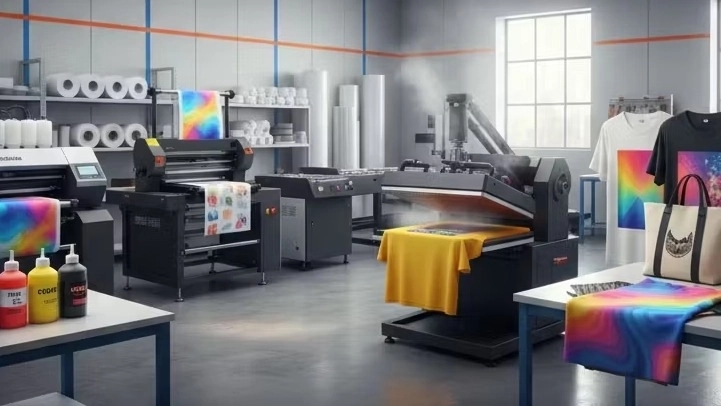
Today, the digital printing industry on fabric and hard objects has undergone tremendous changes. If you work in the field of textiles, advertising, or clothing production, you have definitely heard the names of the two top technologies these days, namely sublimation and dtf. Choosing between these two methods can determine the fate of product quality and the profitability of your business. In this article, we are going to examine the nature, differences, advantages and disadvantages of these two methods in detail and finally introduce you to the best reference for printing services, Shafi'i silk printing, so that you can place your orders with ease.
An introduction to the world of digital printing
In the past, traditional methods such as silk screen printing (which, of course, still has a special place and is the foundation of the Shafii silk printing collection) were used for high circulations. But with the arrival of digital technologies, the need to print complex designs, high-quality photos and color gradients on fabric was felt. In the meantime, two main competitors, sublimation printing and dtf printing, entered the field. Accurately understanding the difference between sublimation and dtf will help you know which method is suitable for cotton t-shirts, which for sportswear and which for ceramic mugs.
What is sublimation printing? (sublimation printing)
Sublimation printing, also known as sublimation printing, is one of the most sustainable printing methods. The term "sublimation" in chemistry means the direct conversion of a solid into a gas. In this process, the special sublimation ink printed on transfer paper is directly converted from solid to gas under high heat and pressure (usually between 180 and 200 degrees Celsius).
When the ink turns into a gas, the polyester holes in the fabric are opened due to heat and the colored gas penetrates into the fabric fibers. After cooling, the holes are closed and the color is trapped inside the fabric. This means that in sublimation and dtf, the sublimation method is such that no layer is felt on the fabric and the print becomes a part of the cloth.
Salient features of sublimation printing
What is DTF printing? (Direct to Film)
On the other side of comparing sublimation and dtf, there is a newer technology called DTF or "direct printing on film". This method came to overcome the limitations of sublimation. In dtf printing, the design is first printed by a special printer on a transparent polymer film (Pet Film). Then, a special adhesive powder (hot metal powder) is sprinkled on the wet ink and melted in the dryer.
Finally, this prepared film is placed on the fabric and the design is transferred to the garment with a heat press. Unlike sublimation where the dye has to penetrate into the fibers, in dtf the design sticks to the surface of the fabric like a very thin and flexible sticker with excellent quality. Shafi'i silk printing specialists provide these services with the highest quality by using the latest DTF machines.
Technical and specialized comparison of sublimation and dtf
To make the right choice, you must know the technical differences between the two. In the following, we will examine these differences in detail.
1. Restriction of fabric type
The most important difference between sublimation and dtf is in the type of fabric they support.
- Sublimation: This method loves polyester! For a clear and vivid sublimation print, your fabric should be at least 60-70% polyester. Sublimation is not done on 100% cotton (cotton) fabrics because natural cotton fibers are not able to absorb sublimation dye gas and the color will disappear with the first wash.
- DTF: This is the strength of dtf. dtf printing has no limitations. You can print on pure cotton, linen, silk, polyester, viscose blends and even leather. If you plan to print on summer cotton t-shirts, dtf is your only option compared to sublimation and dtf.
2. Fabric background color
Another challenge of sublimation is the fabric color.
- Sublimation: Sublimation ink has no masking properties and is transparent. Therefore, it only works on white or very light fabrics (such as pale yellow or very light gray). If you sublimate on a black t-shirt, nothing will be visible.
- DTF: This method uses white ink as the under layer. The dtf machine first prints the main colors and then puts a layer of white color behind it. This will make your design stand out on the darkest fabrics (even pitch black) with full brilliance and clarity. In Shafi'i silk printing, we use the best white inks for complete coverage.
3. Texture and printing sub
- Sublimation: As mentioned, because the dye is gassed and absorbed into the fibers, you don't feel anything when you touch the design. The fabric has the same original softness and the breathability of the garment is maintained.
- DTF: In this method, a thin layer of ink and glue is placed on the work. Although the dtf technology has improved a lot and the layers have become very thin, it is still a little inferior and may block the breathing of the fabric in very large dimensions (full cover). However, the output quality of modern dtfs in Shafii silk printing is very soft and flexible.
The steps of doing work in Shafi'i silk printing
The Shafii silk printing group has optimized the process of ordering to delivery for its customers with years of experience in the field of printing. Whether you are looking for sublimation and dtf or other printing methods, the work steps are carried out professionally:
- Free consultation: Based on your needs (fabric type, circulation and budget), our experts will tell you which method between sublimation and dtf is more suitable for you.
- File design and preparation: Your files are checked and prepared for printing with the highest resolution.
- Printing process: Printing is done using advanced industrial devices. to be In sublimation, transfer papers with a high transfer percentage are used, and in dtf, first-class coated films are used.
- Pressing and transfer: Using calibrated heat presses, the design is fixed on the final product.
- Quality control: All products are checked one by one to ensure that the printing is perfect.
benefits
To sum up the discussion of sublimation and dtf, let's take a list-wise look at the strengths and weaknesses of each.
Advantages of sublimation
- Lifelong durability of the design.
- Lower finished cost for high circulations (if the fabric is polyester).
- Ability to print on hard objects (mugs, plates, puzzles, mobile phone frames, MDF and metal). Yes, sublimation is not only for fabric!
- High production speed in mass circulation.
Advantages of DTF
- Full freedom of action in choosing the material of the fabric (yarn, polyester, linen, etc.).
- Ability to print on any background color (dark and light).
- No need for coating before printing on the fabric.
- Very high clarity and detail in small designs.
- High elasticity and flexibility of the printed design (does not crack).
Various applications in industry
Understanding the difference between sublimation and dtf will help you choose the right method for each product.
Applications of sublimation:
This method is the king of sportswear. All football, volleyball and team sports uniforms you see are produced by sublimation, because the athlete sweats and the clothing must be breathable and not fade from constant washing. Also, sublimation is unrivaled for the production of flags, shawls and scarves, patterned bedspreads and promotional gifts such as mugs and mouse pads. Shafii Silk Printing has a brilliant history in the field of flag and sportswear printing.
Applications of DTF:
This method is the best option for the fashion industry. Black cotton t-shirts with colorful graphics, hoodies, workwear (usually linen), caps, tote bags and sneakers are printed with dtf. If you have a brand that prioritizes the quality of cotton t-shirts, you should definitely choose dtf.
Sustainability and environment
Both sublimation and dtf methods are more environmentally friendly than the old traditional methods because they use very little water. However, dtf has less chemical pollution due to the use of water-based inks and newer standards. In sublimation, the main waste is transfer paper, which can be recycled. Shafii Silk Printing considers itself committed to using raw materials that cause the least harm to the environment.
Why Shafii silk printing is the best choice?
Choosing between sublimation and dtf is a technical issue, but choosing a contractor is a matter of trust and quality. Why should you choose Shafi'i silk printing?
- Technology of the day: We constantly update our machines to have the best color output and the most accurate printing. In digital printing, the quality of the printer head is the first word, and we use industrial and precise heads.
- Original consumables: Using low-quality Chinese inks causes clogging of the head and dull printing. At Shafii Silk Printing, we use standard inks and first-class papers and films that guarantee the brilliance of your design.
- Diversity of services: We are not limited to just one method. In addition to sublimation and dtf, our expertise also includes silk screen printing. This means that we do not have undue prejudice on a particular method and we suggest exactly the method that is in your favor.
- Competitive price: By eliminating middlemen and direct import of some essentials, we have tried to reduce the total price for our dear customers.
- Speed of delivery: We know the value of your time. Our work system is designed so that sublimation and dtf orders are ready to be delivered in the shortest possible time.
Key points for orderers
Before placing your order at Shafii Silk Printing, pay attention to these points:
- File resolution: The higher the quality of your submitted file (preferably 300 DPI), the more beautiful the final output will be in both sublimation and dtf methods.
- File format: Open layer or PNG files without background (for dtf) are the best options.
- Color test: If you have a special organizational color, request a sample. (Sample), because the color mode of the monitor (RGB) is different from the color mode of printing (CMYK).
conclusion
Finally, there is no war between sublimation and dtf; Rather, these two complement each other. Sublimation is great for polyester and rigid fabrics, and dtf works wonders for cotton and dark fabrics. It is important that you know your needs and entrust the work to Kardan.
The Shafii silk printing collection, combining traditional experience and modern knowledge, is ready to be a powerful executive arm alongside your business. If you still have doubts about which method is right for your next project, contact our consultants now. We guarantee to provide you with the highest quality sublimation and dtf printing services at a fair price. Our goal is to make your brand shine.
To view the portfolio and get the price list of sublimation and dtf services, be sure to visit the different sections of the Shafii Silk Printing website and feel the difference in quality. The world of colors is waiting for you.